

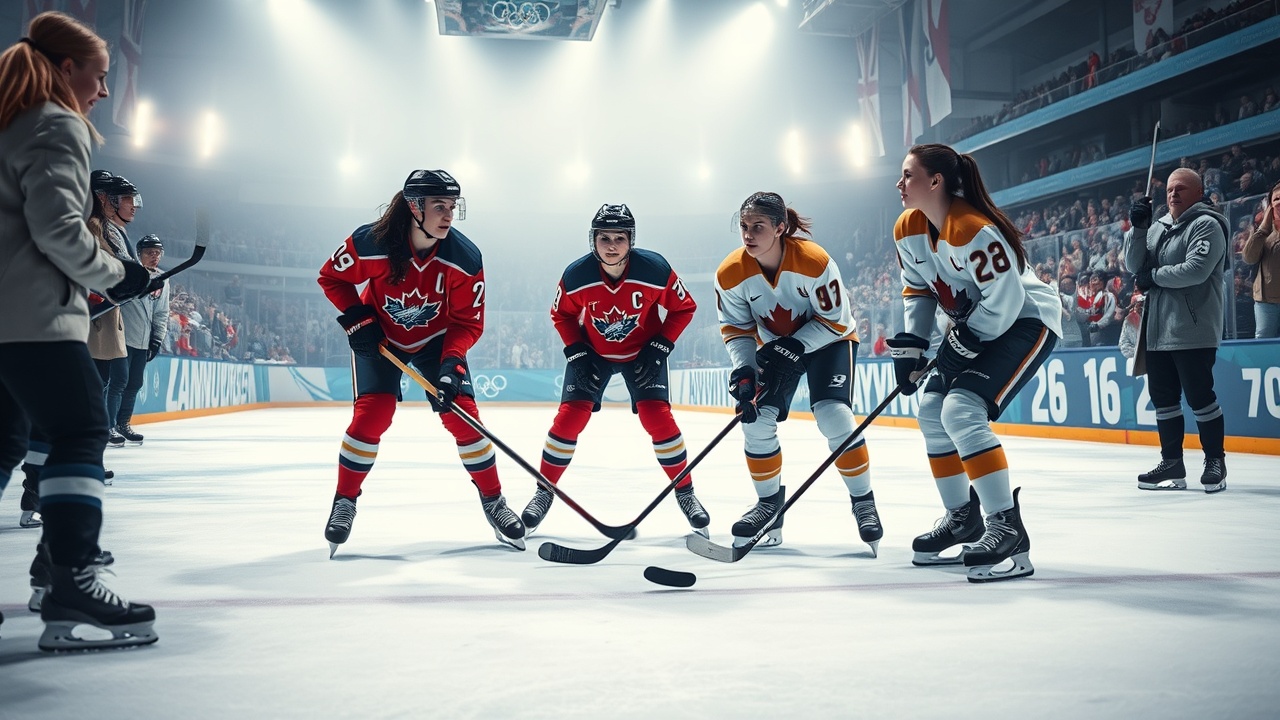
Alina Muller Secures Bronze for Switzerland
In an electrifying overtime thriller, Alina Muller secured a bronze medal for Switzerland with a decisive goal against Sweden, clinching a 2-1 victory. For Muller, this moment isn’t just a personal triumph; it’s a pivotal step forward for women’s hockey in Switzerland and beyond. With 12 years of dedication to the sport, Muller recalls her beginnings, notably when she made headlines by netting her country’s first bronze medal goal during the 2014 Sochi Winter Games at the age of 15.
Milestones at the Milan Cortina Olympics
This year’s Milan Cortina Olympics marked a significant milestone as they were the first to be held after the establishment of the Professional Women’s Hockey League (PWHL) in the summer of 2023. “A few years ago, the stands held only a hundred spectators, but the atmosphere has drastically changed,” Muller remarked, adding that her experiences as a standout player at Northeastern University and now with the Boston Fleet have been part of a larger evolution for the sport. “Each year, competition intensifies. The players are becoming more athletic, and games are faster than ever.”
Competitive Balance in Women’s Hockey
The tournament concluded with two heart-pounding medal finals, both of which went into overtime, with the U.S. team triumphing over Canada 2-1. Hilary Knight, the captain of the U.S., left the Olympics with a gold medal as she closed a remarkable chapter in her career. Importantly, the longstanding dominance of the U.S. and Canada seems to be experiencing a slight decline, as echoed by Canada’s coach Troy Ryan, who observed that the games have become more competitive thanks to the league’s influence.
Ryan, who also oversees the PWHL’s Toronto Sceptres, reflected on the tournament’s closely contested matches, noting the improving performance of international teams that have PWHL players among their ranks. Four years on from Czechia’s historic bronze at the world championships, teams like Switzerland and Sweden emerged as formidable contenders, reaching the medal rounds as fifth- and sixth-seeded teams respectively.
Previous concerns regarding the lopsided nature of games in women’s hockey were alleviated this year, as the results showcased a competitive balance. The most significant victory was recorded by the U.S. over Italy in the quarterfinals, marked by a 6-0 score, which contrasts sharply with the past, where Canada secured a staggering 16-0 win against Italy in 2006.
Future of Women’s Hockey
American sports figures like Jayna Hefford, the PWHL’s executive vice president of hockey operations, hailed this year’s tournament as showcasing the highest quality of Olympic women’s hockey seen to date. Fans noticed a visible PWHL presence in Milan, where teams traded coveted Olympic pins, signifying strong interest in the league.
A wave of expansion appears to be on the horizon for the PWHL, which is preparing to introduce additional franchises following its previous two-team addition. This growth coincides with a promising crop of prospects eligible for this year’s draft, featuring standout players like Caroline Harvey, Abbey Murphy, and Laila Edwards, as well as talented competitors from Sweden and Finland.
Swedish coach Ulf Lundberg noted the PWHL’s transformative effect on the scene, emphasizing its importance for women’s hockey. He observed firsthand the intensity and significance of the league’s competitive matches, considering it a critical development for the sport’s future.
As PWHL players return to a structured league ready to resume action shortly, the dynamics of women’s hockey are set to remain vibrant and visible. U.S. forward Kendall Coyne Schofield expressed optimism about the sustained visibility and growth of women’s hockey in the years to come, underscoring a pivotal change in the landscape of sports for female athletes.