

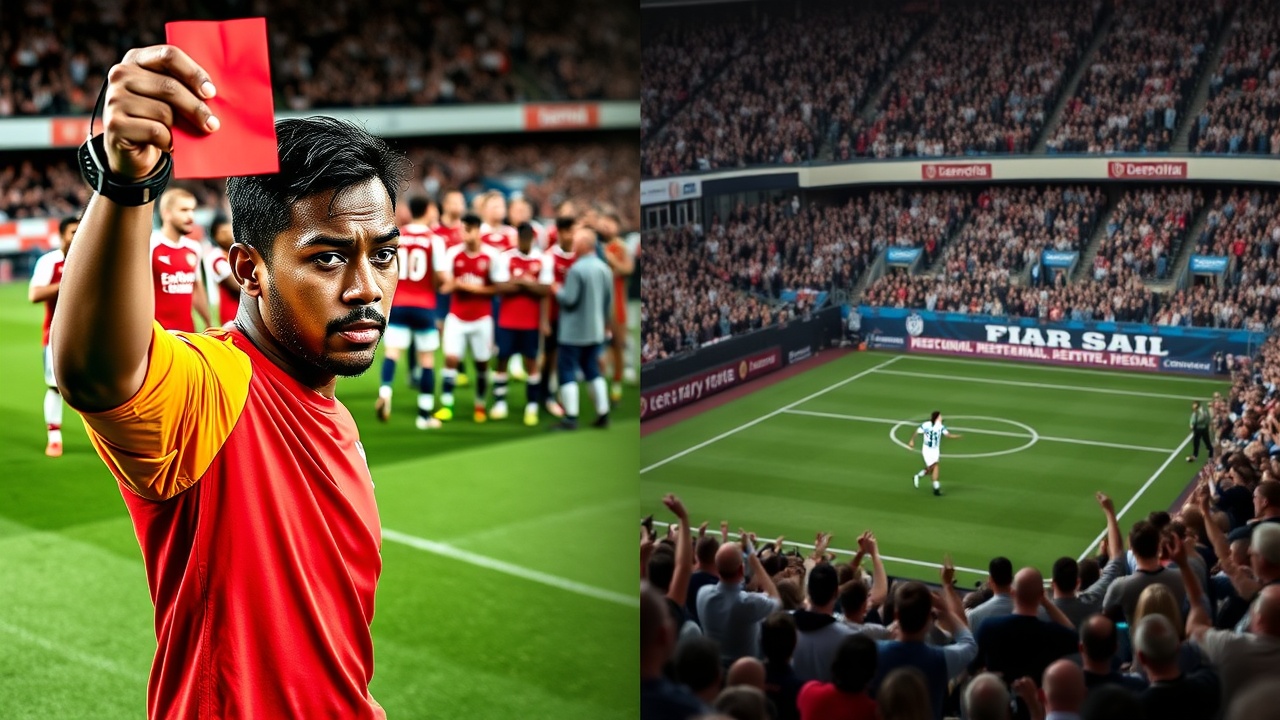
Controversies Surrounding VAR in the Premier League
Controversies surrounding the Video Assistant Referee (VAR) in the Premier League are an ongoing topic of discussion among fans and analysts alike. Each week, moments arise where referee decisions are scrutinized, sparking debates on the accuracy and integrity of these calls. This season, we delve into specific incidents to better understand how VAR decisions are made, focusing on the protocols in place and the governing rules of football.
Notable Incidents This Season
Incident Involving Moisés Caicedo
In one notable incident this season, referee Anthony Taylor faced a pivotal decision regarding Chelsea’s Moisés Caicedo during a match against Arsenal. The incident took place in the 34th minute when Caicedo committed a late tackle on Mikel Merino. Initially, Taylor opted to play advantage as Arsenal was in an attacking position, but after reassessing the tackle, he issued a yellow card to Caicedo for what he deemed a reckless challenge.
However, following a VAR review, overseen by John Brooks, it became clear that Caicedo’s actions posed a significant risk to Merino’s safety. Brooks advised Taylor to review the footage, emphasizing that the tackle was late, committed with excessive force, and made contact above Merino’s ankle with a straight leg. Viewing the incident again, Taylor reversed his initial decision, resulting in a red card for Caicedo, who ended up being sent off. This intervention by VAR was ultimately seen as a necessary correction, aligning with the serious nature of the tackle and reaffirming the importance of player safety.
Incident Involving Piero Hincapié
Another incident worth noting occurred shortly after, at the 40-minute mark, involving Piero Hincapié of Bournemouth and Chelsea’s Trevoh Chalobah. During an aerial challenge, Hincapié inadvertently struck Chalobah’s face with his arm, causing the Chelsea player to fall to the ground. Again, Taylor was faced with a decision and opted to award a free kick to Chelsea while giving Hincapié a yellow card for reckless play.
Upon VAR review, Brooks found no basis to overturn the referee’s decision; they agreed it was merely a reckless action without malicious intent. Taylor’s calm and authoritative handling of the incident was maintained, resulting in a just caution.
Penalty Situation with Jean-Philippe Mateta
VAR was also involved in addressing a penalty situation involving Crystal Palace’s Jean-Philippe Mateta, who, in the midst of taking a penalty after being fouled by Leny Yoro, accidentally touched the ball twice. VAR official Matt Donohue identified this infraction, leading to the penalty being taken again. The rules concerning double touches were clarified at the start of the season, allowing for penalties to stand when a kick succeeds but noting that repeated contacts can rescind such successes. Thus, Donohue’s intervention here was deemed appropriate without necessitating an on-field review.
Disallowed Goal by Jørgen Strand Larsen
In another match, Wolves had an early goal by Jørgen Strand Larsen disallowed due to an offside call. The referee Chris Kavanagh and his assistant deemed Jhon Arias to be interfering with Aston Villa’s goalkeeper Emiliano Martínez, thus ruling the goal invalid. This VAR check confirmed the on-field decision, demonstrating again the importance of real-time communication between referees and VAR officials.
The Role of VAR in Enhancing Officiating
As VAR continues evolving, adherence to clear rules and protocols can aid in maintaining fairness and transparency on the pitch. With these incidents, it’s evident that the VAR system serves as a mandatory check on critical decisions, enhancing the reliability of officiating in football.
Given the complexity and nuances involved in match officiating, regular updates and collaboration among the Premier League clubs and the Professional Game Match Officials Limited (PGMOL) may help promote a deeper understanding of the decision-making process. The aim remains to enforce fairness and clarity, a goal that sports enthusiasts hope for in every match.