
The Role of VAR in Premier League Decisions
The Video Assistant Referee (VAR) consistently stirs debate in the Premier League, notably this season as we scrutinize influential incidents to better understand the decision-making process and adherence to the Laws of the Game. In a recent match involving Manchester United against Bournemouth, key moments ignited discussions around VAR’s procedures and the referee’s interpretations.
Key Incidents in the Match
In the first major incident at the 67th minute, Manchester United’s Amad Diallo was brought down within the penalty area by Bournemouth’s Adrien Truffert, who made upper-body contact. Diallo’s appeal for a penalty was dismissed by referee Stuart Attwell, who judged the contact insufficient to warrant a foul. This decision became particularly contentious as Bournemouth subsequently scored during a quick counterattack immediately following the penalty claim.
“VAR official Craig Pawson reviewed the incident and upheld Attwell’s call, finding no clear error in the on-field decision despite the pressure of the ensuing goal.”
While the VAR process is often viewed with skepticism, Pawson’s review in this scenario was deemed formal due to the goal scored, meaning a more extensive examination of the entire play prior to the goal was necessary. Ultimately, there was consensus that the contact was standard and did not meet the criteria for a penalty, as Attwell noted the players were in a relatively neutral position.
Controversy Over the Penalty Award
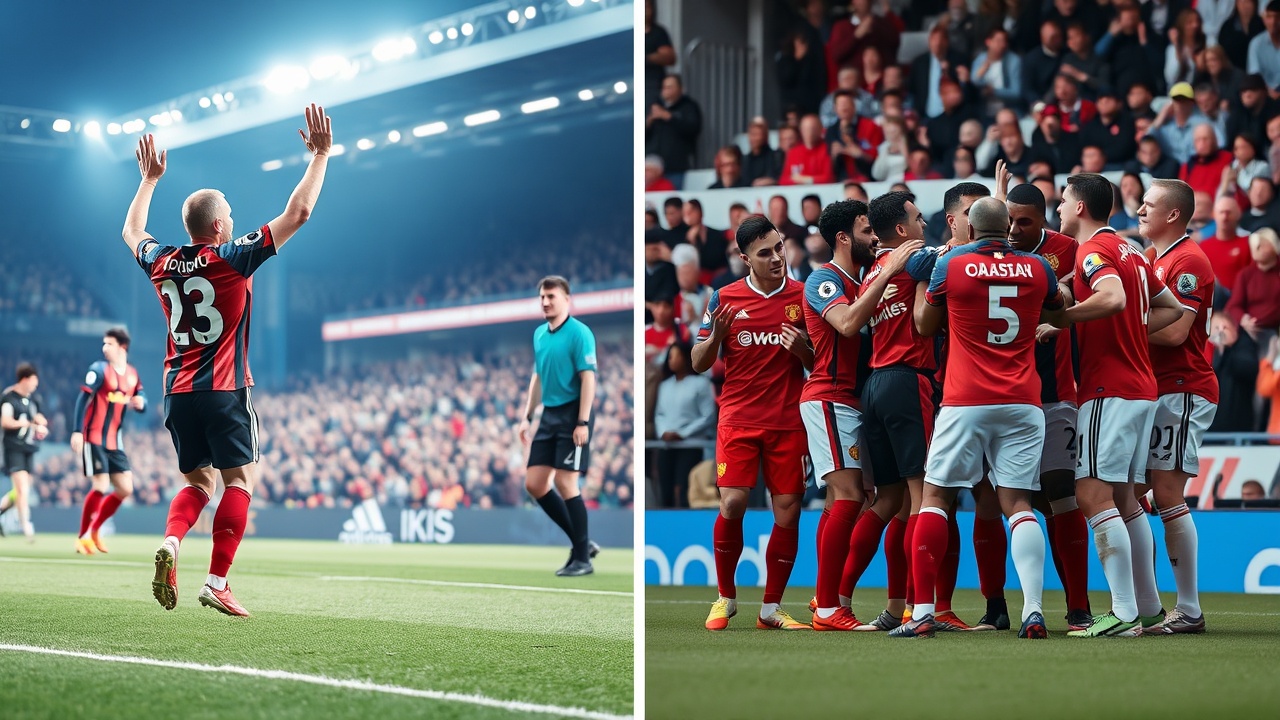
The narrative shifted completely in the 78th minute when a penalty was awarded to Bournemouth. Harry Maguire’s actions drew the attention of the match officials as he appeared to restrict Evanilson‘s movement, pulling him down during a potential scoring opportunity. Attwell, interpreting this foul as a Denial of an Obvious Goal-Scoring Opportunity (DOGSO), issued a penalty kick and expelled Maguire from the match.
“VAR confirmed the decision, agreeing with Attwell’s assessment that Maguire’s holding offense lacked any intent to play the ball.”
This sequence created quite a stir, with many questioning the extent of Maguire’s contact. However, the video evidence consistently supported the officials’ decisions, highlighting that Maguire’s actions were deliberate and obstructive. Thus, while the nuances of the physical contact might spark debate, the conclusion arrived at by both the referee and VAR was consistent: the offense warranted a penalty and a sending-off.
Conclusion
These incidents showcase the complexity of decisions made on the pitch and the rigorous review process by VAR. While opinions may vary on the clarity of contact and its impact, the rules and regulations guiding these calls were applied comprehensively in this encounter. The discussion around VAR’s role in reviewing these decisions is likely to continue, as it remains a critical aspect of modern football officiating.