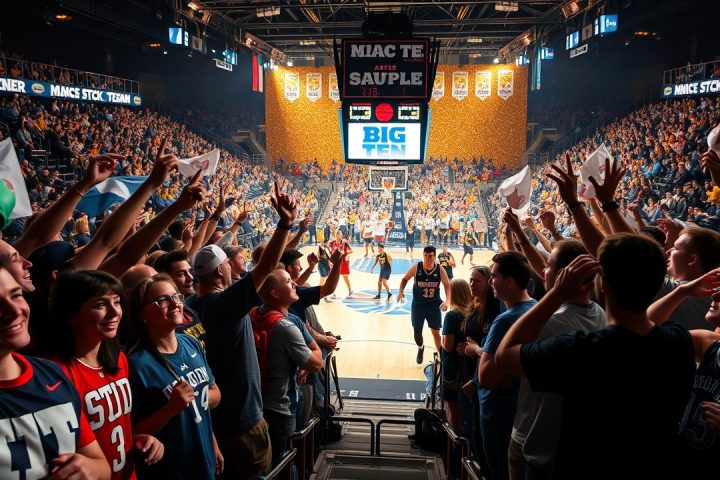


Geography Challenge in College Basketball
This week, two legendary figures in men’s basketball found themselves facing a rather amusing geography challenge: pinpointing the locations of San Diego, California, and Portland, Oregon. St. John’s head coach Rick Pitino jokingly remarked,
“It’s not Alaska,”
when asked about San Diego, his team set to participate in a first-round NCAA Tournament match over 2,400 miles away. Meanwhile, Arkansas coach John Calipari expressed confusion regarding Portland, quipping on ESPN,
“Are we in the United States? I thought they put us in another country,”
just before his team went to compete against Hawaii, over 1,600 miles from their campus.
Geographical Disparities in Postseason Games
These amusing antics highlight a more significant issue in college basketball, where the geographical placement of postseason game venues appears increasingly mismatched with where teams are based. Despite attempts by the NCAA to maintain geographical equilibrium in selecting sites for postseason games, the current landscape shows a pronounced underrepresentation of teams from the Western United States. In fact, only 14.7% of the 68 teams in the tournament hail from west of Kansas this year, a statistic that ties for the lowest representation in the 21st century, according to USA TODAY Sports data. This is compounded by the fact that just 17.5% of the 361 Division I teams are located west of the Central time zone, according to Stats Perform.
Impact of Conference Realignment
This trend raises further concerns, particularly after the dissolution of the once-prominent Pac-12 Conference in 2024, which has left a void with no major conference operating out of the western United States. This year, only two teams from the former Pac-12, UCLA and Arizona, managed to secure spots in the NCAA Tournament—tying for the lowest number of bids historically for this league’s teams that traditionally reside in the Pacific and Mountain time zones. By contrast, just a decade ago, the Pac-12 grabbed seven NCAA bids, while only two years ago, a record 16 teams from west of Kansas took part in the tournament, showcasing the dramatic shift in competitive presence.
The exodus of teams has significantly reshuffled conference affiliations; UCLA and USC chose to join the Big Ten for financial gain, followed by Oregon and Washington, while other schools like Colorado and Arizona migrated to the Big 12. This realignment has contributed to heightened competition in these conferences—now, the Big Ten counts 18 teams, and the Big 12 has expanded to 16. As a result, taking UCLA’s case as an example, the team not only had to compete in a tournament game in Philadelphia but also participated in the Big Ten championship in Chicago, demonstrating the extensive travel that comes with these new affiliations. Coach Mick Cronin remarked,
“We’re not concerned with travel. We’re experienced at it.”
NCAA’s Travel Guidelines and Local Support
The NCAA aims to alleviate the travel burden on teams by following guidelines that suggest keeping teams as geographically proximate to their home regions as possible for the tournaments. However, the process limits flexibility, especially when the scheduling of game locations is established years ahead of time. In this year’s tournament, with only four teams from California receiving bids, a disproportionate number of teams competing in San Diego hail from New York or Philadelphia, not to mention that only one California team, No. 13-seed Cal Baptist from Riverside, is represented.
This situation is concerning from both a marketing and audience-building perspective, specifically for California, a state rich in basketball heritage and a population of passionate fans. Historically, it has produced the most NCAA Tournament winners and best performers since the tournament’s inception in 1939, as highlighted by a BetMGM study.
Attendance Concerns in the West Region
Amid these geographic and competitive shifts, the NCAA continues to designate certain regions of the tournament as “West Region,” including San Jose, where the championship will be determined this month. Nonetheless, the evident lack of local support raises doubts about attendance, as only a fraction of the 16 first-round teams in the West Region are based to the west of Kansas. In fact, among the five top seeds, only Arizona and Gonzaga rank among those westward teams.
Pitino provided a candid assessment of the travel challenges, expecting minimal support from fans in San Diego, saying,
“We’ll have maybe a few hundred people. That’s about it. It’s not ideal traveling to the West Coast, but you deal with it and you just make the best of it.”
Similarly, Calipari, preparing for a six-hour trek to Portland, humorously noted on Sirius XM that
“it’s not all that bad,”
adding a light-hearted edge to the reality that lies ahead. Winning in Oregon would potentially lead Arkansas further along in the tournament, possibly bringing them to San Jose, which, while still a trek, would be slightly more convenient for their fanbase.